
Window building regulations every installer should know
May 1, 2026
Whether you are fitting a replacement window in an existing home or installing a new window in a new build, building regulation for windows applies to your work by law. Get it wrong and you risk failed inspections, costly remedial work and unhappy clients. Get it right and you gain compliance, protect your reputation and give your customer real peace of mind.
In England, all new and replacement window installations must comply with building regulations approval under a set of approved documents. These cover energy efficiency and thermal performance (Part L), ventilation (Part F), fire safety (Part B) and safety glazing (Part K). Most installers self-certify through a competent person scheme and issue a FENSA certificate or work with a building control body such as local authority building control.
Quick reference: building regulations for windows at a glance
| Requirement | New windows | Replacement windows |
|---|---|---|
| U-value (max) | 1.2 W/m2K | 1.4 W/m2K |
| Window Energy Rating | B or better | B or better |
| Trickle vents | Required as standard | Match or exceed original |
| Fire escape opening | Min 0.33m2 / 450mm | Min 0.33m2 / 450mm |
| Safety glazing (Part K) | Required at low level | Required at low level |
| Compliance certificate | FENSA or LABC | FENSA or LABC |
What building regulation for windows do installers need to follow?
In the UK, building regulations are a legal requirement for any new window or replacement window installation. Understanding which rules apply — and how they have changed — can save you from costly mistakes and compliance failures. Building regulations for windows are a set of rules and guidelines ensuring all new and replacement windows meet certain standards for safety, energy efficiency, ventilation, and security.
The key approved documents you need to know are:
Part L — energy performance and heat loss
Part F — ventilation and air quality
Part B — fire safety and escape routes
Part K — protection from impact in glazing
Part M — accessibility
Part O — overheating in new homes
Part L: Energy efficiency and thermal performance
Part L of the building regulations sets out requirements for the energy efficiency of windows. The U-value is a measure of how much heat is lost through a material, and the WER is a measure of the overall energy efficiency of a window.
New windows must have a U-value of no more than 1.2 W/m²K and a Window Energy Rating (WER) of B or better. Replacement windows must have a U-value of no more than 1.4 W/m²K and a WER of B or better. This distinction matters. Confusing the two is one of the most common compliance errors installers make.
New and replacement windows will have to be double-glazed with energy efficient low emissivity glass to comply with the building regulations, unless you are in a listed building or a conservation area, in which case you should consult your local authority.
At Dekko, all PVCu windows use high-quality Deceuninck profile systems. With double and triple glazing options, they can achieve U-values as low as 1.0 W/m²K, supporting compliance with Part L and improving long-term performance.
For properties in a conservation area or listed building, always consult the local authority before specifying.
Part F: Ventilation, trickle vents and air quality
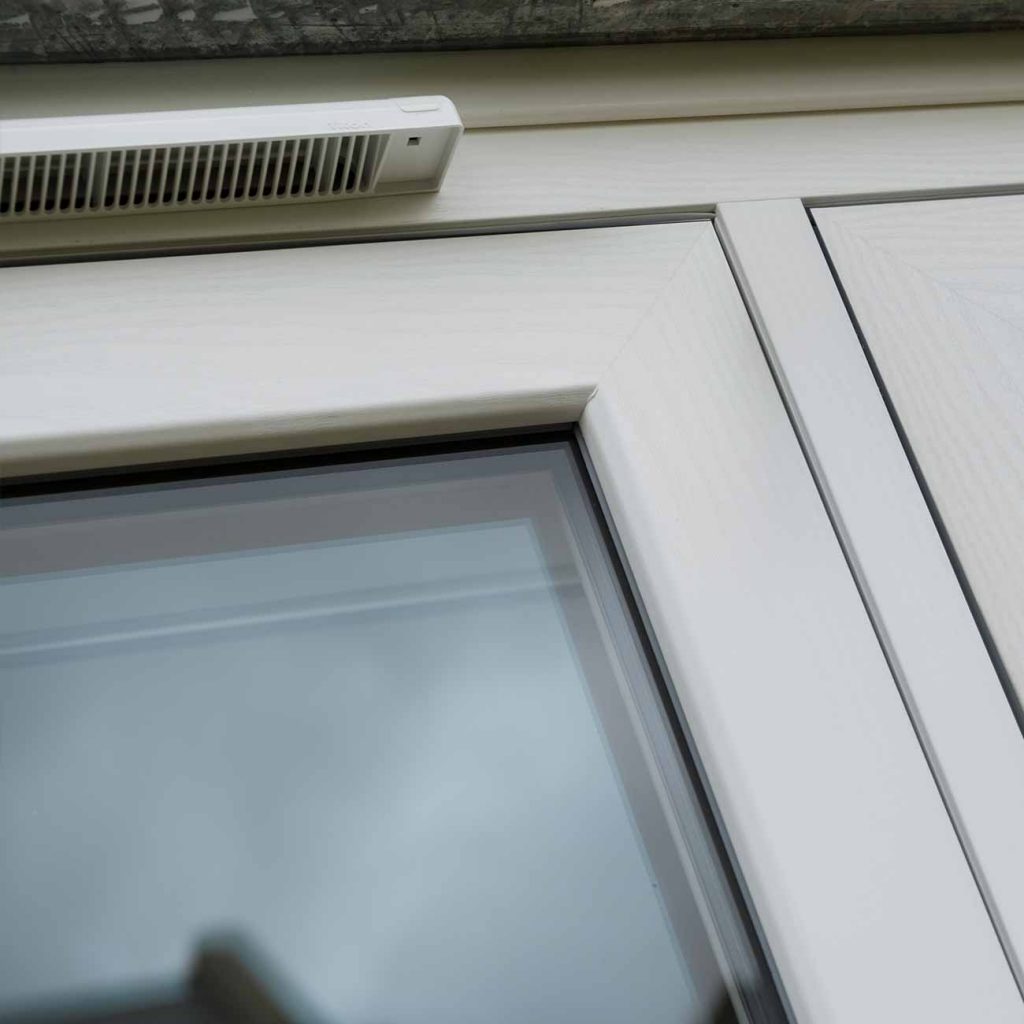
Part F of the building regulations covers the requirements for ventilation in buildings. New and replacement windows must provide adequate ventilation. This can be achieved through background ventilators, trickle vents, or openable windows.
As of June 2022, if the original window already had background ventilation (for example, trickle vents), any replacement window must provide at least the same amount of ventilation. All new-build windows will require trickle vents as standard.
Ventilation is important to remove stale air and moisture from the home, which improves indoor air quality and reduces the risk of mould growth.
In practice, building regulations state that you are required to replace windows like for like. If the original installation already had background ventilation, new windows must provide at least the same amount of ventilation, typically via trickle vents at equal or greater equivalent area.
Part B: Fire safety, escape routes
The regulations set out the vital fire safety measures for windows in the event of a fire. Habitable rooms require a window large enough for emergency escape.
Fire escape windows are required in certain rooms in a home. On the ground floor, fire escape windows are required in any habitable room that does not open directly into a hallway that leads to an exit door. This includes bedrooms, living rooms, and studies. On upper floors up to 4.5 metres from ground level, fire escape windows are required in all habitable rooms that do not have direct access to a protected stairway.
Measurements for a new window opening must be a minimum of 0.33m² and 450mm in height or width.
New and replacement windows in habitable rooms must be able to open to provide emergency escape.
This applies whether you are fitting a new build or a replacement window, so always confirm the hinge specification supports the required clear opening before ordering.
Part K: Safety glazing in critical locations
Part K requires that glazing in critical locations is safe. Safety glazing is required where glass is positioned at low level — specifically below 800mm from the floor in walls and below 1,500mm in doors and side panels.
Impacts with glazing, particularly glazing in doors and door side panels, and at low level in walls and partitions, can result in cutting and piercing injuries. To limit the risk of cutting and piercing injuries, the use of glazing that is reasonably safe is required, such that if breakage did occur, any particles would be relatively harmless. Safe breakage is defined in BS EN 12600 section 4 and BS 6206 clause 5.3. In practice, compliance is achieved by using toughened or laminated safety glass as specified in those standards.
This applies to any window or door you install — including the aluminium and timber window ranges. Always check glass specification before installation on any ground-floor or low-level position.
Part M: Accessibility requirements
Part M ensures buildings are accessible and usable by all individuals, including those with disabilities.
When replacing the main entrance doors in a dwelling unit that has been constructed since 1999, it is important to ensure that the threshold remains level, otherwise the works will not comply with the building regulations as it would be making the threshold worse than it was when constructed. This is to enable people, including those with disabilities, to have continued access to the dwelling.
All new builds are required to meet building regulations Part M, which requires a minimum clear opening width of 775mm.
Part O: Overheating and window design in new homes
Introduced in June 2022, Part O of the building regulations is specifically designed to tackle overheating in new residential buildings. It requires that new homes are designed and constructed to limit unwanted solar gain in summer and to provide adequate means of removing excess heat from indoor environments. Part O directly affects the sizing, positioning, and specification of windows in new builds.
Key requirements include limiting the size of glazed areas to reduce solar gain, particularly in south-facing rooms, and providing sufficient opening area in windows to allow natural ventilation for cooling. Replacement windows in existing homes and conservatories added to existing properties are not affected by Part O.
If you work across new-build and domestic sectors, understanding Part O is non-negotiable for new residential specifications.
Building regulations vs planning permission: what is the difference?
Building regulations and planning permission are separate requirements. If you replace like-for-like windows, you do not need planning permission, except in conservation areas. If you change window style, materials, or size, you may require permission.
Listed buildings and Article 4 conservation areas have stricter requirements.
Always advise your customers to check with their local planning authority before you specify materials for any sensitive property type.
Building control approval, by contrast, is required on virtually every window installation.
Working with Dekko as your window supplier
Meeting building regulations for windows starts with the right product. Dekko manufactures a full range of:
All products are designed to meet current building regulations and Dekko supports installers with consistent product quality, technical guidance and fast turnaround times.
Working with a reliable supplier reduces compliance risk and helps ensure every installation meets required standards first time. To discuss your next project or to get a trade quote, contact the Dekko team.












Nationwide delivery in the UK
From our state-of-the-art factory in Lancashire, our products are transported to installers across the UK. We strive to meet all delivery deadlines to ensure our customers are never delayed. They stock an extensive range of PVCu and ancillary products to give installers easy and convenient access to all the necessary hardware.
Contact Us